


Transatlantic Dialogue on Democratic Governance
Session: Strengthening public trust through transparency and democratic oversight
Speaker
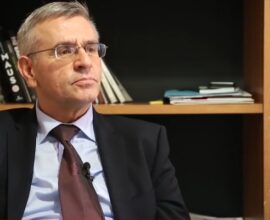
Dr. John Ault
Executive Director, Democracy Volunteers
United Kingdom
Dr. John Ault opened his intervention with a deliberate sentence: “Do as I say, not as I do”.
He explained that this was not a rhetorical flourish, but a conscious framing of a deeper democratic problem the growing gap between what democracies preach and what they practice.
From the very beginning, Dr. Ault challenged the assumption that long-established democracies deserve automatic trust. Democratic credibility, he argued, is not inherited through history or reputation. It is built and rebuilt through constant scrutiny, transparency and the willingness to expose one’s own weaknesses.
Drawing on the work of Democracy Volunteers, a domestic election observation organization in the United Kingdom, he demonstrated how independent, non-partisan election observation strengthens democracy.
Observation means questioning procedures, testing laws against reality and identifying vulnerabilities – even in systems that claim there is “nothing wrong” with their elections.
Through concrete different examples from the United Kingdom, Italy, Canada, Finland, Norway and the Netherlands, Dr. Ault exposed a persistent double standard: practices tolerated in mature democracies would be considered unacceptable if they occurred in emerging ones. Family voting, proxy voting, weak enforcement of ballot secrecy and informal influence were all presented as normalized risks hiding behind democratic self-confidence.
His message was uncompromising: democracies cannot demand standards from others that they refuse to apply to themselves.
When democratic systems adopt a “do as I say, not as I do” approach, public trust erodes not because citizens reject democracy, but because they see inconsistency and hypocrisy at its core.
Referring to the Venice Commission and the OSCE Copenhagen Document, Dr. Ault reaffirmed that both international and domestic election observation are essential safeguards of democratic legitimacy. Evidence-based oversight, he stressed, is not a threat to democracy it is one of its strongest defenses.
He concluded with a direct and uncomfortable question – one that cut to the core of democratic credibility: If established democracies fail to apply the standards they promote, why should emerging democracies be expected to follow them?
Dr. Ault warned that demanding transparency, accountability and electoral integrity from others, while refusing to fully implement those same principles at home, undermines democratic legitimacy itself. Such double standards, he argued, do not strengthen democracy-they weaken it, eroding public trust even within long-established democratic systems.
His final message was unequivocal: democracy cannot survive on authority alone – it survives on consistency, credibility and the willingness to lead by example.